
What is BEAM Robotics?
Simple, Autonomous, and Inspired by Nature
BEAM robotics is a branch of robotics that emphasizes simplicity, robustness, and biomimetic design, focusing on creating robots that are not just functional but also emulate the simplicity and efficiency of natural biological systems. Pioneered by Mark Tilden, BEAM robots operate using analog circuits and typically use simple components like solar cells and sensors to achieve autonomous behavior.
BEAM is an acronym standing for Biology, Electronics, Aesthetics, Mechanics[^1].
-
Biology — It’s tough to beat 4 billion years of evolution; the world around us is a wonderful source of inspiration and education. Bear in mind, of course, that unlike Mother Nature, you also have the advantage of gears, motors, bearings, and good glues!
-
Electronics — It kind of goes without saying, but this is what we’ll use to drive our creations. BEAM robotics, though, strives for rich behaviors from simple circuits. Here’s the key: simple and understandable circuits, surprisingly complex in behavior.
-
Aesthetics — This just means your creations should look good. I’m an engineer, but even I appreciate a good-looking design. Besides, if a design looks “clean,” it’s more likely to work (and easier to test / debug) than a design that’s tangled and unruly.
-
Mechanics — This is the less-than-obvious secret of many successful BEAMbots — with a clever mechanical design, you can reduce the complexity of the rest of your robot (reducing the number of motors and sensors, for example).
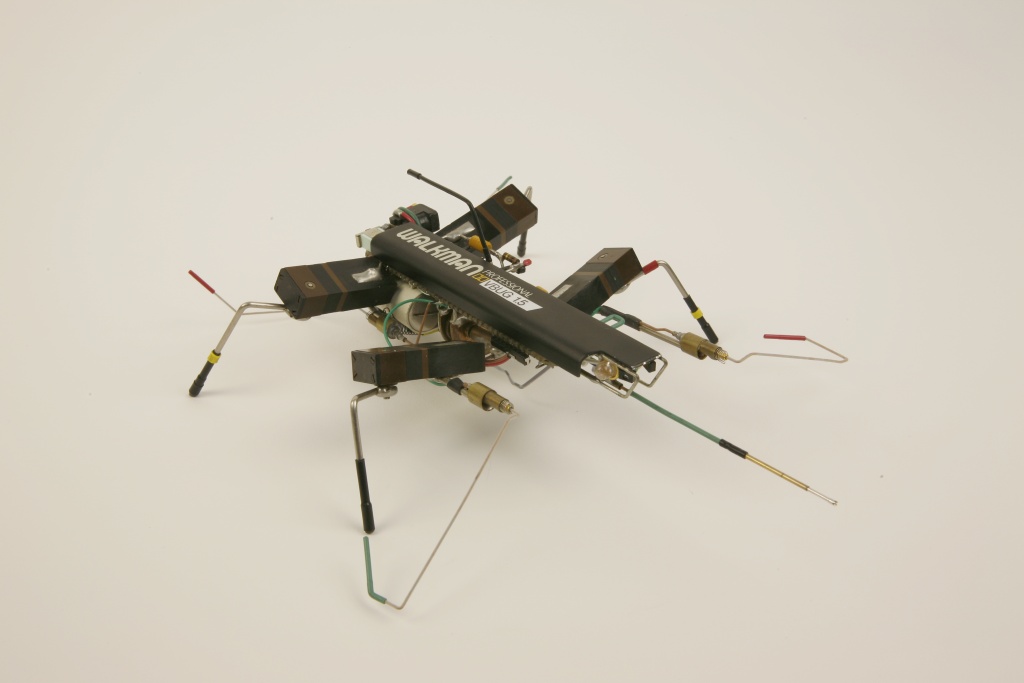
Name: Vbug 1.5 aka. “Walkman”
Designer: Mark W. Tilden
Build Date: Dec 15, 1993 - April 1, 1994 (completion)
Source: http://grant.solarbotics.net/walkman.htm
Some videos about BEAM
Discovery Channel - Robots Rising (1998)
Reference
- BEAM robotics
- A bit of background on BEAM
- Mark Tilden
- The Walkman page aka Vbug 1.5
- Vintage BEAM Videos
[^1]“BEAM is an acronym standing for Biology, Electronics, Aesthetics, Mechanics” - solarbotics.net